Over the three months ending in May 2026, the median home sale in Grand Lake, Colorado closed at $452,000, down 9.65 percent from the same window a year earlier. Price per square foot fell even harder, down 14 percent to $528. Look at the average sale price from the same source's most recent monthly reading, though, and the direction flips entirely: up 10.1 percent year over year, to roughly $1.05 million.
Same town. Same few weeks. Two numbers that should move together and instead pull in opposite directions.
If you're comparing Grand Lake to other Grand County towns before making an offer, this is the detail that matters more than either headline figure. A falling median and a rising average in the same market almost never means prices are confused. It means you're not looking at one market. You're looking at two, filed under one name.
Two Markets Wearing the Same Zip Code
Grand Lake's single-family and condo segments have been telling different stories for months, and the gap explains the paradox better than any single price point can.
| Segment | Recent price signal | Time on market |
|---|---|---|
| Single-family homes | Median $785,000 (May 2026), average sale price $814,933 | About 70 days |
| Condos | Median $427,250 | About 72 days |
Listing prices on single-family homes in Grand Lake currently span from $465,000 to $3.4 million, a spread wide enough that a handful of high-end closings can move the average without moving the middle. Condos, meanwhile, cluster in a tighter, lower band, from $180,000 to $988,000. When more of the closed sales in a given month are condos, the median drops even if the underlying value of any single home hasn't changed at all.
That's not a theory. It's what happened last fall. Sky-Hi News reporting on the Grand County market found that Grand Lake's median price dropped 35 percent in October 2025 compared with the prior year, driven by a surge in condo inventory of more than 270 percent, which pushed the town's months of supply to 14. A market is generally considered balanced somewhere between four and six months of supply. Fourteen is a market where condo sellers are competing hard for a shrinking pool of buyers, while single-family sellers further up the price ladder are not.
Grand Lake wasn't alone in this. The same reporting found Granby's single-family median fell about 17 percent in October 2025 with inventory up nearly 30 percent, and Winter Park's single-family prices held steady while its condo prices fell 15 percent that month and more than 10 percent year to date. The pattern across Grand County is consistent: single-family and condo inventory are behaving like two separate products with two separate demand curves, and any headline median that blends them will tell you less than the split itself.
Morgan Keeler, president of the Grand County Board of Realtors, described the shift in inventory directly, noting that for the first time in years, there are actually listings to show. That's a genuine change in a county where sellers spent most of the past several years holding the leverage. It's also a reminder that a buyer's market on paper doesn't mean every segment softened equally.
Which Lake Is It Actually On
Here's a complication that a median price, however carefully split, still won't resolve for you: not every listing marketed as "Grand Lake" waterfront sits on Grand Lake.
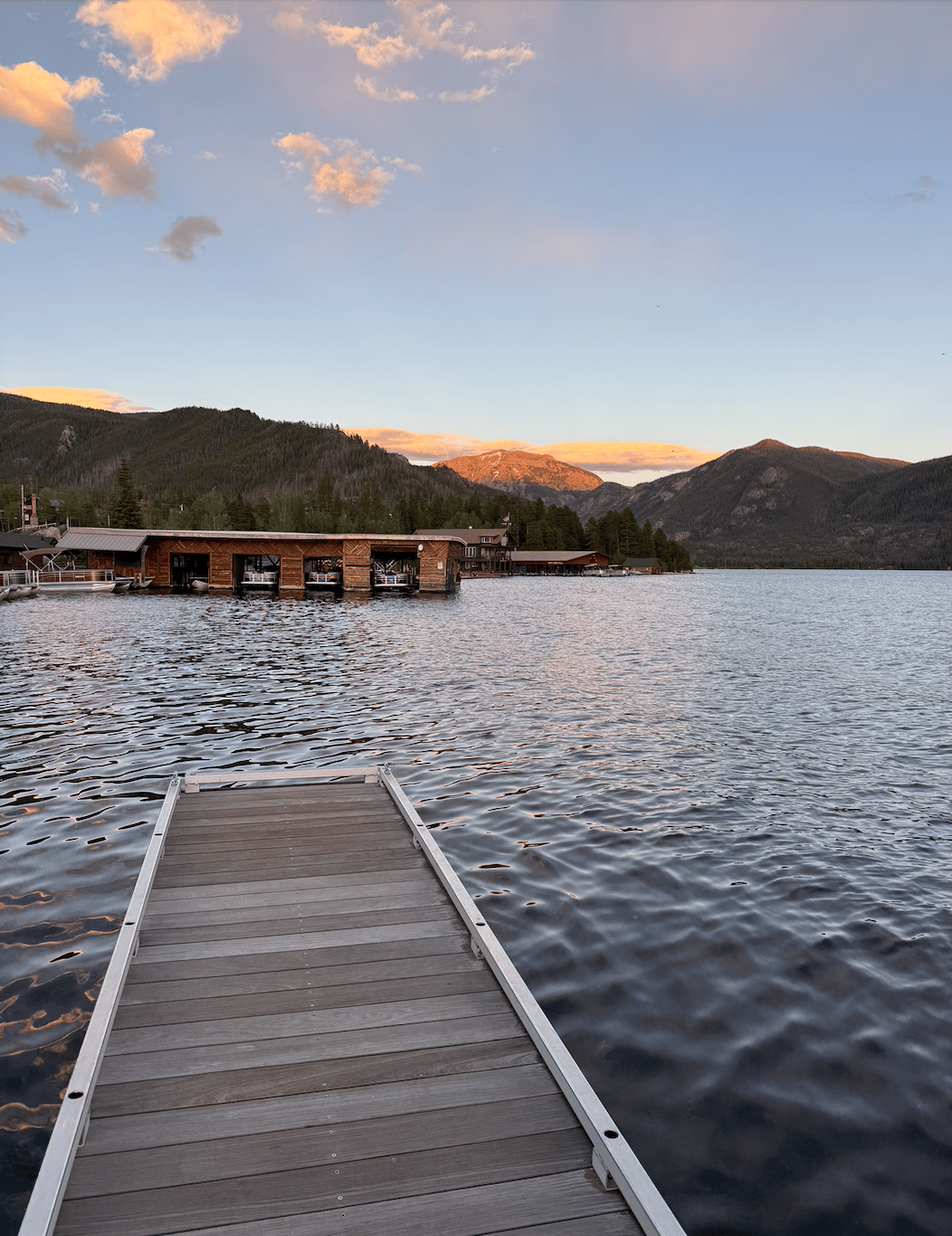
The town of Grand Lake sits on the shore of Colorado's largest and deepest natural lake, formed during the Pinedale glaciation period. As part of the Colorado-Big Thompson Project, that lake forms a continuous body of water with two reservoirs downstream, Shadow Mountain Lake and Lake Granby. For water delivery purposes, the three function as one connected system. For real estate purposes, they are three distinct addresses with three distinct sets of access rules, and a listing agent's use of "Grand Lake" in a headline doesn't guarantee which one your dock actually touches.
One current example makes the point concrete. Heartwood Ranch, a 7-bedroom, 8-bath, 4,868-square-foot compound on roughly 3.73 acres, is zoned within Grand Lake's Tourist District and marketed as Grand Lake property. Its nearly 700 feet of water frontage sits between Shadow Mountain Lake and Lake Granby, not on Grand Lake itself. That distinction matters for anything from HOA rules to which marina you'll use to how the property will comp against others when you eventually sell.
Access within the town's actual municipal boundary carries its own constraint worth knowing before you fall in love with a listing photo. The East Inlet, an open space area owned by the Bureau of Reclamation and maintained as a boat ramp by the Town of Grand Lake, is the only point of motorized boat access to Grand Lake within town limits. The town also operates free public boat slips near Headwaters Marina, across from Gene Stover Lakefront Park and steps from the historic downtown boardwalk, but those slips are day use only. Overnight mooring isn't permitted there, and docking is prohibited between 2 a.m. and 5 a.m. under the town's boating ordinance. If your plan involves keeping a boat in the water overnight without building or buying a permitted private dock, that plan needs to account for where the property actually sits relative to the East Inlet ramp, not just how close it is to the water.
The Grand Lake Yacht Club, one of the highest-elevation yacht clubs anywhere, is part of what gives the town's waterfront its character. It's also a reminder that lake access here has always been curated rather than universal, which is exactly why the fine print matters more in Grand Lake than in a market where every shoreline lot works the same way. Buyers researching lake-adjacent inventory will also run into listings near Columbine Lake, a separate, privately stocked, non-motorized lake with its own HOA clubhouse and amenities. It's a genuinely different product again, and worth knowing before you assume every "lake" result in a search is comparable.
The Rental Math Depends on Which Side of the Line You're On
If part of your evaluation includes short-term rental income, the town line does real financial work here too.
Within Grand Lake's town limits, a short-term rental operator pays a flat annual license fee of $600, plus a one-time $165 initial application fee, regardless of how many bedrooms the property has or how many guests it sleeps. Elsewhere in Grand County, the permit fee structure is occupancy-based, calculated at roughly $100 per person the listing is advertised to sleep, meaning a home advertised for eight guests could carry an $800 annual fee for the same use. A two-bedroom condo and a six-bedroom lake house pay the same town fee in Grand Lake proper. Cross into the unincorporated county and that math changes by bedroom count.
The town has also chosen not to cap short-term rental density or require a minimum ownership period before an owner can start renting, a path some other resort towns have taken. Town Manager Steve Kudron summed up the position plainly: the town remains open to creative solutions, but until STRs become a problem, they'll keep welcoming visitors.
That openness has consequences worth knowing if you're comparing Grand Lake to a full-time-resident-heavy town. Town planning documents put Grand Lake's housing stock at approximately 820 units, of which only about 28 percent are occupied by full-time residents, owners or long-term renters. That ratio is close to what it was back in 2010, when the town had 712 units. In other words, this isn't a recent shift toward second-home dominance. It's the baseline the town has operated on for well over a decade, and it means the "comps" a buyer pulls for a Grand Lake property are drawn overwhelmingly from a second-home and investment-property pool, not a pool of year-round households.
What This Actually Means Before You Make an Offer
None of this makes Grand Lake a bad place to buy. It makes it a market where the single number most buyers lead with, the median, is doing double duty for two very different products, a shifting inventory mix, and three physically connected but legally distinct bodies of water, all under one town name.
Before comparing Grand Lake's numbers to Granby, Winter Park, or anywhere else on your shortlist, ask which segment the number you're looking at actually describes, which of the three lakes a specific listing sits on, and whether the fee structure you're planning around matches the side of the town line the property falls on. Those three questions will tell you more than any single median ever will.
If you're weighing Grand Lake against other Grand County towns and want someone who can walk the specific parcel, the specific shoreline, and the specific zoning line with you, John Sanderson has spent years working these exact distinctions across Grand County. Reach out for current listings and a straight read on what a given price actually buys.